primer.ml.tokenization
Tokenization: how text becomes the integers a model actually reads
Run: python -m primer.ml.tokenization
New to the notation (sums, subscripts)? Every symbol is decoded where it
appears, and primer.notation teaches them all from zero. This lesson
builds on the embedding table of primer.ml.big_picture.
Level 1: The practitioner's guide
In one sentence. A tokenizer cuts text into pieces from a fixed vocabulary and hands the model a number for each piece; every price, rate limit, context window and latency figure you meet is counted in those pieces, and where their boundaries fall explains a whole family of odd model behaviour.
When you need it. On every call, because you are billed per token, but you feel it on particular days: when you estimate a bill, when a prompt overflows the context window, when users who write in Hindi or Japanese cost several times what English users cost, when a model miscounts the letters in a word or mis-adds two numbers, when a fine-tuning dataset is quoted in tokens, or when you switch model generations and the same prompt suddenly counts differently. The tell: a number that should be simple (how long is this text?) that you cannot answer without running the model's own tokenizer. This lesson's toy tokenizer, trained on English, spends 1.73 characters per token on an English sentence and 0.38 on the same sentence in Hindi, 4.5 times as many tokens for the same meaning. You never train a tokenizer unless you pretrain a model; you only ever count with one, and choose models partly by theirs.
Your options. From the quickest estimate to the most committed:
| Option | What it does | What it gives you | What it costs | Where it lives |
|---|---|---|---|---|
| A rule of thumb | About 4 characters or 0.75 words per token of English prose | An instant estimate: 1,000 tokens is about 750 words | Wrong by several-fold for code, JSON and non-English text | Your head, and this lesson's estimate_tokens |
| Counting with the model's own tokenizer | Runs the real tokenizer offline (tiktoken, Hugging Face tokenizers, SentencePiece) | Exact counts for any model whose tokenizer ships with its weights | The right tokenizer files per model family; counts do not transfer between families | Your code |
| Counting through the API | A vendor endpoint counts a whole request: system prompt, tools, images, PDFs | Counts for models whose tokenizer is not published; free on Anthropic's API, with its own rate limit | One request per count; a close estimate rather than the exact bill | The API |
| Reading usage after each call | Every response reports the input and output tokens it consumed | The exact billed numbers, and the cache reads | Nothing beyond logging it | The API response |
| Shaping the text | Prefers prose to nested JSON, trims whitespace and decimals, shortens identifiers in tool outputs | Fewer tokens per call at the same meaning | Engineering time, and a risk of hurting clarity | Your prompt and your tool outputs |
| Choosing the model by its tokenizer | Picks a family whose vocabulary covers your languages | Shorter sequences and lower bills for non-English text | Larger vocabularies cost embedding parameters, paid by the vendor | The model card: vocab_size |
| Training or extending a vocabulary | Learns merges from your own corpus | The shortest sequences for your domain | The model must be trained or retrained with it | Your training stack |
How to choose. Start from who runs the tokenizer.
- A hosted model: count before you send when the size matters (context fit, routing between models) and read usage after every call for the bill. Recount when you change model generations: Anthropic's documentation says the tokenizer introduced with Claude Opus 4.7 produces about 30% more tokens for the same text than earlier models did.
- An open model: the tokenizer ships with the weights; load the pair together and never count with another family's tokenizer, because the pieces and the ids are unrelated.
- A multilingual product: budget per language with the real tokenizer, never with the English rule of thumb.
- A task about letters or digits (spelling, counting characters, arithmetic): give the model a tool or spell the item out, because the tokens hide the letters.
- A model with a chat template: apply it. Instruction-tuned models expect their special tokens in the right places, and a prompt built by hand produces ids the model was not trained on.
- Whatever you pick, measure with the tokenizer of the model you will actually call. The rule of thumb is for napkins.
What it costs. Tokens are the unit of four bills.
- Money. Two meters: this lesson's example call, 2,000 input tokens and a
500-token answer at \$3 and \$15 per million, costs \$0.0135, and a million
such calls cost \$13,500 (
estimate_cost). Hosted APIs price output tokens several times higher than input tokens (5× across Anthropic's price list), so a verbose answer costs more than a long prompt. - Latency. Each output token is one full step of generation, so answer
length sets the wait;
primer.ml.inferenceputs the step at about 4.78 ms for an 8-billion-parameter model on one GPU. - Context. The window is counted in tokens, so the 4.5× gap between English and Hindi in this lesson's run is also a 4.5× gap in how much text fits.
- Vocabulary. A bigger kit means shorter sequences but a larger embedding
table: GPT-2's 50,257 rows of width 768 are 38.6 million parameters, 32%
of its smallest model (
primer.ml.transformer). Llama 3 grew to a 128K vocabulary, 100K from the tiktoken kit plus 28K for other languages, and its paper reports better compression as a result.
What breaks.
- Letters the model never saw. " strawberry" is two ids in this lesson's
tokenizer,
strawandberry, not ten letters. Counting the r's means recalling a spelling, not reading one. - Digits that split by length. " 1234" is one token and " 12345" is two (" 1234", "5"), and "1234" at the start of a line is three, so place values never line up. Some newer tokenizers split digits into groups of at most three to soften this.
- A leading space changes the token. " cat" is id 303 and "cat" is ids 99 and 268; the model must learn that both mean cat. A prompt that ends mid-word, or a prefix that gains a trailing space, changes the ids and breaks a cached prefix.
- The same meaning at several times the price. Hindi in this lesson costs 4.5× English; Petrov et al. (2023) measured differences of up to 15 times between languages on production tokenizers. Budget per language.
- The wrong tokenizer. Fine-tuning data tokenized with another family's kit trains the model on unrelated ids. Load tokenizer and weights from the same checkpoint.
- Estimates carried across generations. A count measured on one model can be 30% short on its successor. Recount with the model id you will run.
In the wild. GPT-2 introduced byte-level BPE with a pre-tokenization
regex, and most language-model tokenizers still follow that design. OpenAI's
tiktoken ships the cl100k_base and o200k_base vocabularies and claims to
be 3 to 6 times faster than a comparable open-source tokenizer; Hugging Face
tokenizers and Google's SentencePiece cover the open models, SentencePiece
writing spaces as the visible symbol ▁. BERT uses WordPiece and T5 uses
Unigram. Llama 3's vocabulary is 128K entries, and Mistral's byte-fallback
tokenizer guarantees that no character ever becomes an unknown token.
Anthropic's count_tokens endpoint counts a full request (system prompt,
tools, images and PDFs) free of charge, subject to a rate limit of 5,000 to
20,000 requests per minute by usage tier, and every Messages API response
reports its usage. The papers are linked at the end of the lesson.
Go deeper. Level 2 trains a tokenizer by hand on "low lower lowest" in three merges, replays the merges to encode a word it never saw, drops to bytes so that nothing is ever unknown, meets WordPiece and Unigram, and prints the exact pieces behind each quirk above. If you only needed to count and budget, you are done.
Level 2: How it works, from scratch
Level 2 builds the kit of bricks from nothing, starting with what a token is.
1. Tokens: building words from a fixed kit of bricks
Everyday picture. A box of Lego with a fixed set of bricks. Common shapes have a ready-made brick; anything unusual gets assembled from smaller bricks. You can build anything, but some builds take many more bricks than others. A tokenizer is that kit for text: a fixed vocabulary of pieces (typically 32,000 to 200,000 of them), each with a number, its token id.
Tiny worked example. With a kit that contains the, un, believ and
able, "the" takes 1 brick and "unbelievable" takes 3: un + believ +
able. The model never sees the letters; it sees a short list of ids such
as [262, 403, 11009, 540].
| Approach | Kit size | "unbelievable" | Problem |
|---|---|---|---|
| Whole words | huge (every form of every word, every name) | 1 piece, if it's in the kit | words not in the kit become <unk>; typos break |
| Single bytes | 256 | 12 pieces | sequences 4-5× longer, and attention cost grows with length squared |
| Subwords | 32k to 200k | ~3 pieces | the middle ground every modern LLM uses |
flowchart LR
  T["'the unbelievable'"] --> TOK["tokenizer<br/>(fixed kit of pieces)"]
  TOK --> P["pieces: 'the' | ' un' | 'believ' | 'able'"]
  P --> IDS["ids: 262, 403, 11009, 540"]
  IDS --> EMB["embedding table<br/>one vector per id"]
  EMB --> M["the model"]
Reading it: text enters on the left and never reaches the model as
text. The tokenizer cuts it into pieces from its fixed kit and swaps each
piece for its number. Those numbers pick rows from the embedding table (see
primer.ml.big_picture), and only those vectors reach the model. Everything
the model knows about spelling it had to learn through this narrow window.
(The ids shown are illustrative.)
In code: trained_tokenizer builds this lesson's toy kit, and
ByteBPE.encode turns any text into its list of ids.
Why it matters. Everything downstream is counted in tokens: price, speed, and how much fits in the context window.
2. Byte Pair Encoding (BPE): learning the kit from data
Everyday picture. A court stenographer inventing shorthand. Whatever pair of letters they write most often gets its own squiggle. Then the most common pair including that squiggle gets one too, and so on, until they have as many squiggles as they can remember.
Tiny worked example. Training text "low lower lowest". Start from single
letters and repeatedly merge the most frequent neighbouring pair
(train_char_bpe reproduces this exactly):
| Step | Most frequent pair | New token | Text becomes |
|---|---|---|---|
| Start | none | none | l o w · l o w e r · l o w e s t |
| 1 | l + o (3 times) | lo | lo w · lo w e r · lo w e s t |
| 2 | lo + w (3 times) | low | low · low e r · low e s t |
| 3 | low + e (2 times) | lowe | low · lowe r · lowe s t |
At step 1, l+o and o+w are tied at 3; ties go to the pair seen first.
flowchart LR
  T[Training text] --> S[Split into characters]
  S --> C[Count adjacent pairs]
  C --> M[Merge the most frequent pair<br/>record the merge rule]
  M -->|vocab not full yet| C
  M -->|vocab full| V[Vocabulary + ordered merge list]
Reading it: training is a loop around two boxes. "Count adjacent pairs" looks at every neighbouring pair of symbols in the corpus; "Merge" glues the winner into one new symbol everywhere and appends that rule to an ordered list. The loop exits when the vocabulary reaches its target size. The output is not just a vocabulary but the ordered merge list, and encoding depends on that order.
The math and the code. Each round picks the pair with the largest count:
Level 3: the formula and its symbols
$$ \text{count}(a, b) = \sum_{w} f_w \cdot n_w(a, b) $$
Symbols
| Symbol | Meaning here | In the example |
|---|---|---|
| $a, b$ | two symbols that sit side by side | l and o |
| $w$ | one distinct word of the training text | "lower" |
| $\sum_{w}$ | "add up the following over every distinct word" | low, lower, lowest |
| $f_w$ | how many times word $w$ occurs in the text | 1 each |
| $n_w(a, b)$ | how many times $a$ is immediately followed by $b$ inside $w$ | 1 in each word |
| $\text{count}(a, b)$ | the pair's total, the number BPE ranks by | 3 |
In words: "for each distinct word, count how often the pair appears inside it, multiply by how often the word occurs, and add everything up."
With the numbers: count(l, o) = 1·1 (low) + 1·1 (lower) + 1·1 (lowest) =
3; count(e, r) = 1·1 (lower) = 1. train_char_bpe computes the same
totals with a Counter.
Level 3: in Python
In Python:
# f_w: how often each distinct word occurs
f = {"low": 1, "lower": 1, "lowest": 1}
# n_w(a, b): a immediately followed by b inside w
def n(w, a, b):
    return sum(1 for i in range(len(w) - 1) if w[i] == a and w[i + 1] == b)
def count(a, b):
    # Σ_w f_w · n_w(a, b)
    return sum(f_w * n(w, a, b) for w, f_w in f.items())
count("l", "o"), count("e", "r")  # → (3, 1)
In code: train_char_bpe runs the count-and-merge loop and returns one
MergeStep per round, holding the winning pair, its count, the new token
and the text after the merge (one row of the table above).
Why it matters. Frequent strings end up as single tokens and rare ones stay in pieces, which is exactly why token counts differ from word counts, and why a tokenizer trained mostly on English is cheap for English and expensive for everything else (section 6).
3. Encoding new text: replay the merges in order
Everyday picture. Following a recipe card: do step 1 everywhere it applies, then step 2, and so on. Skipping ahead would give a different dish.
Tiny worked example. Encode "lowest" with the three merges learned
above: l o w e s t → (merge 1) lo w e s t → (merge 2) low e s t →
(merge 3) lowe s t. Result: 3 tokens. A word never seen in training still
works: "slow" → s low; "newer" matches no merge and stays as letters.
flowchart LR
  W["'lowest' as letters<br/>l o w e s t"] --> R1["merge 1: l+o<br/>lo w e s t"]
  R1 --> R2["merge 2: lo+w<br/>low e s t"]
  R2 --> R3["merge 3: low+e<br/>lowe s t"]
  R3 --> OUT["no learned merge applies<br/>tokens: lowe | s | t"]
Reading it: each box applies one merge rule, in the order the rules were learned, to every place it fits. The word shrinks from 6 symbols to 3. It stops when none of the remaining neighbouring pairs is in the rule list.
The code. encode_char_bpe repeatedly finds, among the pairs present,
the one learned earliest, merges it, and loops. Training and encoding
agree because they apply rules in the same order.
Why it matters. Encoding is deterministic: the same text always gives the same ids, which is what makes prompt caching and cost estimates possible.
4. Byte-level BPE: nothing is ever unknown
Everyday picture. Every file on a computer, whatever it holds, is a sequence of bytes: numbers from 0 to 255. If the smallest bricks in the kit are those 256 byte values, then no text can ever be unbuildable: emoji, Chinese, source code or garbage all come apart into bytes.
Tiny worked example. In UTF-8 (the standard way to store text as bytes) "a" is one byte, 97; "é" is two bytes, 195 169; "🙂" is four bytes, 240 159 153 130. An untrained byte-level tokenizer turns "é🙂" into 6 tokens. After training on English, " password" is one token, id 291, because it was frequent.
flowchart LR
  T["Text: 'Reset your password'"] --> P["Pre-tokenize (regex)<br/>'Reset' | ' your' | ' password'"]
  P --> B["UTF-8 bytes per chunk<br/>' your' = 32 121 111 117 114"]
  B --> R["Replay merges, earliest first<br/>inside each chunk only"]
  R --> I["Token ids<br/>346 377 309 328 291"]
  I --> D["Decode: look up bytes per id,<br/>concatenate, UTF-8 decode"]
Reading it: encoding runs left to right. A regular expression (a
text-matching pattern) first cuts the text into chunks, each keeping its
leading space; merges never cross a chunk boundary. Each chunk becomes raw
bytes (ids 0-255). The tokenizer then applies whichever learned merge came
earliest among the pairs present, until none applies. The ids shown are what
this module's toy tokenizer produces: "Reset" is two tokens (Re set),
" password" is one. Decoding is the reverse lookup: every id maps to a fixed
byte string, and concatenating them restores the exact original bytes. That
is why a byte-level tokenizer round-trips any text.
The code. ByteBPE is train_char_bpe with bytes instead of letters,
ids 0-255 for the bytes and 256, 257, ... for each merge. GPT-2, GPT-4's
cl100k_base, Llama 3 and most current LLMs work this way.
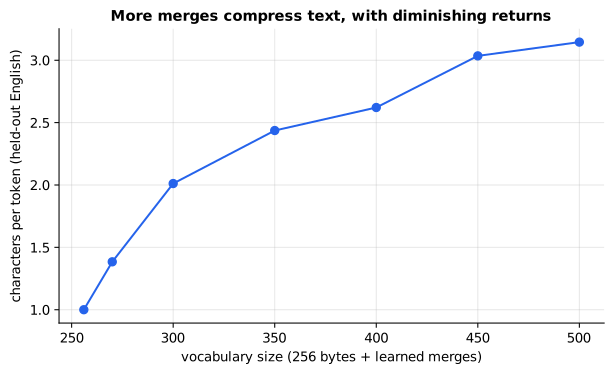
Reading it: the x-axis is vocabulary size: 256 raw bytes plus the number of merges learned. The y-axis is compression, how many characters of held-out English each token covers on average. At 256 (no merges) every byte is a token, so the value is 1. The first few dozen merges capture the most frequent pairs (" t", "he", " the") and the curve climbs steeply; later merges capture rarer strings and the curve flattens. (Our toy corpus runs out of repeated strings near 500; real corpora keep going.) Production tokenizers sit far to the right, at 50k to 200k entries, and reach about 4 characters per token on English. Bigger kits mean shorter sequences but a larger embedding table and output layer.
In code: ByteBPE.train learns the byte merges, ByteBPE.encode and
ByteBPE.decode make the round trip, and compression_curve trains
tokenizers of growing size and measures each one for the figure above.
Try it: the tokenizer below is this lesson's own, with its 144 learned merges. Drag the merges down to 0 and every byte is its own token; drag them back up and watch frequent pieces such as " the" and " password" fuse, one merge at a time, while characters per token climbs like the curve above. Then type a word the corpus never saw, or an accent or an emoji, and watch it stay in small pieces.
Why it matters. No "unknown token" failures, ever, for any input. The price is that unfamiliar scripts fall back to near-byte level and cost many more tokens.
5. The cousins: WordPiece and Unigram
Everyday picture. BPE glues the most common pair. WordPiece glues the most inseparable pair: two pieces that almost never appear apart, like "Q" and "u" in English. Unigram works the other way round: start with a huge kit and keep throwing out the bricks you'd miss least.
Tiny worked example. On "low lower lowest", BPE's first merge is l+o.
WordPiece's first merge is s+t: "s" and "t" each appear exactly once, and
always together.
flowchart TB
  subgraph BPE["BPE (GPT, Llama)"]
    b1[start small] --> b2[merge most frequent pair] --> b3[grow to target size]
  end
  subgraph WP["WordPiece (BERT)"]
    w1[start small] --> w2["merge pair with best<br/>count(ab) / count(a)·count(b)"] --> w3[grow to target size]
  end
  subgraph UG["Unigram (T5, SentencePiece default)"]
    u1[start huge] --> u2[drop pieces whose loss<br/>hurts likelihood least] --> u3[shrink to target size]
  end
Reading it: the two top rows grow a vocabulary bottom-up and differ only in how they rank candidate pairs. The bottom row prunes top-down. All three end with a fixed kit and a rule for cutting new text into pieces from it.
The math. WordPiece ranks pairs by
Level 3: the formula and its symbols
$$ \text{score}(a, b) = \frac{\text{count}(ab)}{\text{count}(a) \cdot \text{count}(b)} $$
Symbols
| Symbol | Meaning here | In the example |
|---|---|---|
| $\text{count}(ab)$ | how often $a$ is immediately followed by $b$ | count(st) = 1 |
| $\text{count}(a)$ | how often $a$ appears at all | count(s) = 1 |
| $\text{count}(b)$ | how often $b$ appears at all | count(t) = 1 |
| fraction bar | divide: pairs are rewarded when their parts rarely appear apart |
In words: "how often the two appear together, divided by how often each appears at all."
With the numbers: score(s, t) = 1 / (1 · 1) = 1.0; score(l, o) =
3 / (3 · 3) = 0.33. WordPiece merges s+t first (wordpiece_scores).
Level 3: in Python
In Python:
f = {"low": 1, "lower": 1, "lowest": 1}
# how often a symbol, or a pair written together, appears
def count(piece):
    return sum(f_w * w.count(piece) for w, f_w in f.items())
def score(a, b):
    # count(ab) / (count(a) · count(b))
    return count(a + b) / (count(a) * count(b))
score("s", "t"), round(score("l", "o"), 2)  # → (1.0, 0.33)
BERT marks continuation pieces with ## ("un", "##believ", "##able").
SentencePiece is a library that runs BPE or Unigram directly on raw text,
writing spaces as the visible symbol ▁.
Why it matters. Different model families segment the same text differently, so their token counts and costs differ. Always count with the tokenizer of the model you'll actually call.
6. Tokens are the unit of cost, speed and memory
Everyday picture. A taxi meter that ticks per token, not per mile, with a pricier meter for the return trip: output tokens usually cost several times more than input tokens.
Tiny worked example. A prompt of 2,000 tokens with a 500-token answer, at example prices of \$3 per million input tokens and \$15 per million output tokens: 0.006 + 0.0075 = \$0.0135. A million such calls cost \$13,500.
flowchart LR
  P["prompt text"] --> TI["count input tokens<br/>meter A: $ per million in"]
  TI --> M[model]
  M --> TO["count output tokens<br/>meter B: $ per million out (pricier)"]
  TO --> BILL["bill = A + B"]
  TI -.-> CTX["also: must fit the<br/>context window"]
Reading it: two meters run on every call. Input tokens are counted once on the way in; they also have to fit in the model's context window (the dotted arrow). Output tokens are counted on the way out, and each one also takes a full step of generation, so they drive latency as well as cost.
The math and the code.
Level 3: the formula and its symbols
$$ \text{cost} = \frac{T_{in}}{10^6}\,p_{in} + \frac{T_{out}}{10^6}\,p_{out} $$
Symbols
| Symbol | Meaning here | In the example |
|---|---|---|
| $T_{in}$ | input tokens in the call | 2,000 |
| $T_{out}$ | output tokens generated | 500 |
| $10^6$ | one million, because prices are quoted per million tokens | 1,000,000 |
| $p_{in}$ | price per million input tokens, in dollars | 3 |
| $p_{out}$ | price per million output tokens, in dollars | 15 |
In words: "input tokens in millions times the input price, plus output tokens in millions times the output price."
With the numbers: 2,000/1,000,000 × 3 + 500/1,000,000 × 15 = 0.006 +
0.0075 = \$0.0135 (estimate_cost).
Level 3: in Python
In Python:
T_in, T_out = 2_000, 500
# dollars per million tokens
p_in, p_out = 3, 15
round(T_in / 10**6 * p_in + T_out / 10**6 * p_out, 4)  # → 0.0135
Rule of thumb: English prose averages about 4 characters per token,
or 0.75 words per token, so 1,000 tokens ≈ 750 words
(estimate_tokens, tokens_to_words). Use it for quick estimates; count
with the real tokenizer for anything that matters.
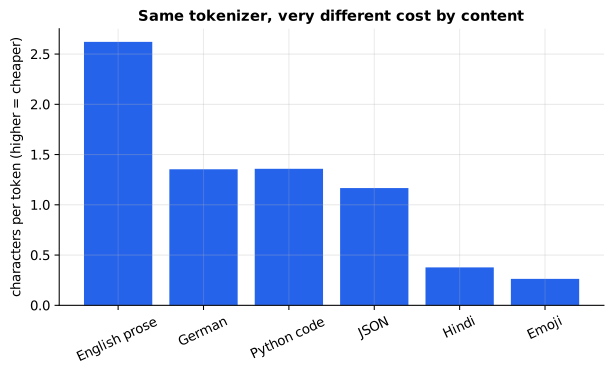
Reading it: each bar is one kind of text encoded by the same English-trained tokenizer from this module; taller bars mean each token carries more text, so the content is cheaper. English prose scores highest because the merges were learned from English. Code and JSON score lower because symbols and unusual identifiers were rarely merged. German shares the alphabet but not the words. Hindi and emoji fall below one character per token: each character is 3-4 UTF-8 bytes and few of those byte pairs were ever merged, the worst case of byte-level fallback.
In code: chars_per_token computes each bar: the length of the text
divided by the number of ids ByteBPE.encode returns for it.
Why it matters. The same request can differ several-fold in cost, latency and context usage depending on language and content: dense JSON, code, tables and non-English text all need more tokens than English prose.
7. Quirks the tokenizer explains
Everyday picture. Reading through frosted glass that only shows whole bricks. You can tell which bricks are there, but not the letters printed on them.
Tiny worked example (this module's toy tokenizer):
| Text | Tokens | What it explains |
|---|---|---|
" cat" vs "cat" |
[303] vs [99, 268] (c at) |
a leading space makes a different token; the model must learn they mean the same |
" 1234" vs " 12345" |
[' 1234'] vs [' 1234', '5'] |
digits split by length and context, so place values don't line up: one reason arithmetic is hard |
" strawberry" |
[' straw', 'berry'] |
2 ids, not 10 letters: "how many r's?" is hard |
flowchart LR
  W["' strawberry'"] --> T["tokenizer"] --> I["ids 396, 311"]
  I --> M["model sees two ids<br/>no letters, no count of r"]
  Q["'how many r's?'"] --> M
Reading it: the question is about letters, but the letters were
discarded before the model saw anything. It has to have memorized how
straw and berry are spelled from seeing them in text, which is why
spelling and letter-counting questions trip up models that handle much
harder reasoning.
The code. ByteBPE.tokens(text) shows the pieces for any string; the
demo prints these cases.
Why it matters. These quirks explain surprising behaviour: miscounted letters, shaky arithmetic, odd handling of rare names. Some newer tokenizers split digits into fixed groups of up to 3 to reduce the arithmetic problem.
In 20 seconds
- Text is split into subword pieces by BPE: start from characters or bytes and repeatedly merge the most frequent neighbouring pair.
- Byte-level BPE can encode anything with no unknown token.
- Cost, latency and context limits are counted in tokens; English is about 4 characters (0.75 words) per token, while code and non-English text need more tokens.
Self-test questions
Why subwords instead of whole words or characters? Words give a huge vocabulary and unknown words; characters make sequences several times longer, and attention cost grows with the square of length. Subwords keep common strings short and still encode anything.
How does BPE training proceed, step by step, on "low lower lowest"? Split into letters, count neighbouring pairs, and merge the most frequent: l+o (3), then lo+w (3), then low+e (2). Record each merge; to encode, replay the merges in the order learned.
Why can a byte-level BPE tokenizer never produce an unknown token? Its base vocabulary is all 256 byte values, and every string is a sequence of UTF-8 bytes, so in the worst case text falls back to single bytes.
What does WordPiece do differently from BPE? It merges the pair with the highest count(ab) / (count(a)·count(b)), which favours pairs whose parts rarely appear apart, instead of the most frequent pair.
Your users write in Hindi. What changes in your estimates? Expect noticeably more tokens for the same content: higher cost and latency, and less text per context window. Measure with the actual tokenizer.
Why are LLMs bad at counting letters and at long arithmetic? They see token ids, not characters, and numbers split into chunks that don't line up with place value.
What does a call with 2,000 input and 500 output tokens cost at \$3/\$15 per million? 0.006 + 0.0075 = \$0.0135. And 1,000 tokens is about 750 English words.
The papers behind this lesson
- Sennrich, Haddow & Birch (2015), Neural Machine Translation of Rare Words with Subword Units. https://arxiv.org/abs/1508.07909. Brought byte pair encoding, a 1990s compression trick, to language models as a way to build open-vocabulary subword units. annotated companion
- Radford et al. (2019), Language Models are Unsupervised Multitask Learners (GPT-2). https://cdn.openai.com/better-language-models/language_models_are_unsupervised_multitask_learners.pdf. Introduced byte-level BPE with a pre-tokenization regex, the design most LLM tokenizers still follow.
- Kudo & Richardson (2018), SentencePiece. https://arxiv.org/abs/1808.06226. A language-independent tokenizer library that works on raw text and encodes spaces as the symbol ▁.
- Kudo (2018), Subword Regularization. https://arxiv.org/abs/1804.10959. Introduced the Unigram language-model tokenizer that prunes a large vocabulary down instead of merging up.
Further reading
- Sennrich et al., Neural Machine Translation of Rare Words with Subword Units (the BPE paper, 2015): https://arxiv.org/abs/1508.07909
- Andrej Karpathy, Let's build the GPT Tokenizer (video): https://www.youtube.com/watch?v=zduSFxRajkE
- Karpathy's
minbpe(minimal, clean byte-level BPE): https://github.com/karpathy/minbpe - OpenAI
tiktoken(fast BPE used by GPT models): https://github.com/openai/tiktoken - Hugging Face LLM course, BPE chapter: https://huggingface.co/learn/llm-course/chapter6/5
- Hugging Face LLM course, WordPiece chapter: https://huggingface.co/learn/llm-course/chapter6/6
- Hugging Face LLM course, Unigram chapter: https://huggingface.co/learn/llm-course/chapter6/7
- Kudo & Richardson, SentencePiece (2018): https://arxiv.org/abs/1808.06226
- Kudo, Subword Regularization (the Unigram LM, 2018): https://arxiv.org/abs/1804.10959
- Petrov et al., Language Model Tokenizers Introduce Unfairness Between Languages (2023): https://arxiv.org/abs/2305.15425
1r""" 2# Tokenization: how text becomes the integers a model actually reads 3 4Run: `python -m primer.ml.tokenization` 5 6New to the notation (sums, subscripts)? Every symbol is decoded where it 7appears, and `primer.notation` teaches them all from zero. This lesson 8builds on the embedding table of `primer.ml.big_picture`. 9 10## Level 1: The practitioner's guide 11 12**In one sentence.** A tokenizer cuts text into pieces from a fixed 13vocabulary and hands the model a number for each piece; every price, rate 14limit, context window and latency figure you meet is counted in those 15pieces, and where their boundaries fall explains a whole family of odd model 16behaviour. 17 18**When you need it.** On every call, because you are billed per token, but 19you feel it on particular days: when you estimate a bill, when a prompt 20overflows the context window, when users who write in Hindi or Japanese 21cost several times what English users cost, when a model miscounts the 22letters in a word or mis-adds two numbers, when a fine-tuning dataset is 23quoted in tokens, or when you switch model generations and the same prompt 24suddenly counts differently. The tell: a number that should be simple (how 25long is this text?) that you cannot answer without running the model's own 26tokenizer. This lesson's toy tokenizer, trained on English, spends 1.73 27characters per token on an English sentence and 0.38 on the same sentence in 28Hindi, 4.5 times as many tokens for the same meaning. You never train a 29tokenizer unless you pretrain a model; you only ever count with one, and 30choose models partly by theirs. 31 32**Your options.** From the quickest estimate to the most committed: 33 34| Option | What it does | What it gives you | What it costs | Where it lives | 35|---|---|---|---|---| 36| A rule of thumb | About 4 characters or 0.75 words per token of English prose | An instant estimate: 1,000 tokens is about 750 words | Wrong by several-fold for code, JSON and non-English text | Your head, and this lesson's `estimate_tokens` | 37| Counting with the model's own tokenizer | Runs the real tokenizer offline (tiktoken, Hugging Face tokenizers, SentencePiece) | Exact counts for any model whose tokenizer ships with its weights | The right tokenizer files per model family; counts do not transfer between families | Your code | 38| Counting through the API | A vendor endpoint counts a whole request: system prompt, tools, images, PDFs | Counts for models whose tokenizer is not published; free on Anthropic's API, with its own rate limit | One request per count; a close estimate rather than the exact bill | The API | 39| Reading usage after each call | Every response reports the input and output tokens it consumed | The exact billed numbers, and the cache reads | Nothing beyond logging it | The API response | 40| Shaping the text | Prefers prose to nested JSON, trims whitespace and decimals, shortens identifiers in tool outputs | Fewer tokens per call at the same meaning | Engineering time, and a risk of hurting clarity | Your prompt and your tool outputs | 41| Choosing the model by its tokenizer | Picks a family whose vocabulary covers your languages | Shorter sequences and lower bills for non-English text | Larger vocabularies cost embedding parameters, paid by the vendor | The model card: `vocab_size` | 42| Training or extending a vocabulary | Learns merges from your own corpus | The shortest sequences for your domain | The model must be trained or retrained with it | Your training stack | 43 44**How to choose.** Start from who runs the tokenizer. 45 46- A hosted model: count before you send when the size matters (context fit, 47 routing between models) and read usage after every call for the bill. 48 Recount when you change model generations: Anthropic's documentation says 49 the tokenizer introduced with Claude Opus 4.7 produces about 30% more 50 tokens for the same text than earlier models did. 51- An open model: the tokenizer ships with the weights; load the pair 52 together and never count with another family's tokenizer, because the 53 pieces and the ids are unrelated. 54- A multilingual product: budget per language with the real tokenizer, 55 never with the English rule of thumb. 56- A task about letters or digits (spelling, counting characters, arithmetic): 57 give the model a tool or spell the item out, because the tokens hide the 58 letters. 59- A model with a chat template: apply it. Instruction-tuned models expect 60 their special tokens in the right places, and a prompt built by hand 61 produces ids the model was not trained on. 62- Whatever you pick, measure with the tokenizer of the model you will 63 actually call. The rule of thumb is for napkins. 64 65**What it costs.** Tokens are the unit of four bills. 66 67- Money. Two meters: this lesson's example call, 2,000 input tokens and a 68 500-token answer at \$3 and \$15 per million, costs \$0.0135, and a million 69 such calls cost \$13,500 (`estimate_cost`). Hosted APIs price output 70 tokens several times higher than input tokens (5× across Anthropic's 71 price list), so a verbose answer costs more than a long prompt. 72- Latency. Each output token is one full step of generation, so answer 73 length sets the wait; `primer.ml.inference` puts the step at about 4.78 ms 74 for an 8-billion-parameter model on one GPU. 75- Context. The window is counted in tokens, so the 4.5× gap between English 76 and Hindi in this lesson's run is also a 4.5× gap in how much text fits. 77- Vocabulary. A bigger kit means shorter sequences but a larger embedding 78 table: GPT-2's 50,257 rows of width 768 are 38.6 million parameters, 32% 79 of its smallest model (`primer.ml.transformer`). Llama 3 grew to a 128K 80 vocabulary, 100K from the tiktoken kit plus 28K for other languages, and 81 its paper reports better compression as a result. 82 83**What breaks.** 84 85- **Letters the model never saw.** " strawberry" is two ids in this lesson's 86 tokenizer, ` straw` and `berry`, not ten letters. Counting the r's means 87 recalling a spelling, not reading one. 88- **Digits that split by length.** " 1234" is one token and " 12345" is two 89 (" 1234", "5"), and "1234" at the start of a line is three, so place 90 values never line up. Some newer tokenizers split digits into groups of at 91 most three to soften this. 92- **A leading space changes the token.** " cat" is id 303 and "cat" is ids 93 99 and 268; the model must learn that both mean cat. A prompt that ends 94 mid-word, or a prefix that gains a trailing space, changes the ids and 95 breaks a cached prefix. 96- **The same meaning at several times the price.** Hindi in this lesson 97 costs 4.5× English; Petrov et al. (2023) measured differences of up to 15 98 times between languages on production tokenizers. Budget per language. 99- **The wrong tokenizer.** Fine-tuning data tokenized with another family's 100 kit trains the model on unrelated ids. Load tokenizer and weights from the 101 same checkpoint. 102- **Estimates carried across generations.** A count measured on one model 103 can be 30% short on its successor. Recount with the model id you will run. 104 105**In the wild.** GPT-2 introduced byte-level BPE with a pre-tokenization 106regex, and most language-model tokenizers still follow that design. OpenAI's 107tiktoken ships the `cl100k_base` and `o200k_base` vocabularies and claims to 108be 3 to 6 times faster than a comparable open-source tokenizer; Hugging Face 109tokenizers and Google's SentencePiece cover the open models, SentencePiece 110writing spaces as the visible symbol `▁`. BERT uses WordPiece and T5 uses 111Unigram. Llama 3's vocabulary is 128K entries, and Mistral's byte-fallback 112tokenizer guarantees that no character ever becomes an unknown token. 113Anthropic's `count_tokens` endpoint counts a full request (system prompt, 114tools, images and PDFs) free of charge, subject to a rate limit of 5,000 to 11520,000 requests per minute by usage tier, and every Messages API response 116reports its `usage`. The papers are linked at the end of the lesson. 117 118**Go deeper.** Level 2 trains a tokenizer by hand on "low lower lowest" in 119three merges, replays the merges to encode a word it never saw, drops to 120bytes so that nothing is ever unknown, meets WordPiece and Unigram, and 121prints the exact pieces behind each quirk above. If you only needed to 122count and budget, you are done. 123 124## Level 2: How it works, from scratch 125 126Level 2 builds the kit of bricks from nothing, starting with what a token 127is. 128 129## 1. Tokens: building words from a fixed kit of bricks 130 131**Everyday picture.** A box of Lego with a fixed set of bricks. Common 132shapes have a ready-made brick; anything unusual gets assembled from smaller 133bricks. You can build *anything*, but some builds take many more bricks than 134others. A **tokenizer** is that kit for text: a fixed vocabulary of pieces 135(typically 32,000 to 200,000 of them), each with a number, its **token id**. 136 137**Tiny worked example.** With a kit that contains `the`, `un`, `believ` and 138`able`, "the" takes 1 brick and "unbelievable" takes 3: `un` + `believ` + 139`able`. The model never sees the letters; it sees a short list of ids such 140as `[262, 403, 11009, 540]`. 141 142| Approach | Kit size | "unbelievable" | Problem | 143|---|---|---|---| 144| Whole words | huge (every form of every word, every name) | 1 piece, if it's in the kit | words not in the kit become `<unk>`; typos break | 145| Single bytes | 256 | 12 pieces | sequences 4-5× longer, and attention cost grows with length squared | 146| **Subwords** | 32k to 200k | ~3 pieces | the middle ground every modern LLM uses | 147 148```mermaid 149flowchart LR 150 T["'the unbelievable'"] --> TOK["tokenizer<br/>(fixed kit of pieces)"] 151 TOK --> P["pieces: 'the' | ' un' | 'believ' | 'able'"] 152 P --> IDS["ids: 262, 403, 11009, 540"] 153 IDS --> EMB["embedding table<br/>one vector per id"] 154 EMB --> M["the model"] 155``` 156 157**Reading it:** text enters on the left and never reaches the model as 158text. The tokenizer cuts it into pieces from its fixed kit and swaps each 159piece for its number. Those numbers pick rows from the embedding table (see 160`primer.ml.big_picture`), and only those vectors reach the model. Everything 161the model knows about spelling it had to learn through this narrow window. 162(The ids shown are illustrative.) 163 164**In code:** `trained_tokenizer` builds this lesson's toy kit, and 165`ByteBPE.encode` turns any text into its list of ids. 166 167**Why it matters.** Everything downstream is counted in tokens: price, 168speed, and how much fits in the context window. 169 170## 2. Byte Pair Encoding (BPE): learning the kit from data 171 172**Everyday picture.** A court stenographer inventing shorthand. Whatever 173pair of letters they write most often gets its own squiggle. Then the most 174common pair *including* that squiggle gets one too, and so on, until they 175have as many squiggles as they can remember. 176 177**Tiny worked example.** Training text "low lower lowest". Start from single 178letters and repeatedly merge the most frequent neighbouring pair 179(`train_char_bpe` reproduces this exactly): 180 181| Step | Most frequent pair | New token | Text becomes | 182|-------|--------------------|-----------|---------------------------------| 183| Start | none | none | l o w · l o w e r · l o w e s t | 184| 1 | l + o (3 times) | lo | lo w · lo w e r · lo w e s t | 185| 2 | lo + w (3 times) | low | low · low e r · low e s t | 186| 3 | low + e (2 times) | lowe | low · lowe r · lowe s t | 187 188At step 1, `l+o` and `o+w` are tied at 3; ties go to the pair seen first. 189 190```mermaid 191flowchart LR 192 T[Training text] --> S[Split into characters] 193 S --> C[Count adjacent pairs] 194 C --> M[Merge the most frequent pair<br/>record the merge rule] 195 M -->|vocab not full yet| C 196 M -->|vocab full| V[Vocabulary + ordered merge list] 197``` 198 199**Reading it:** training is a loop around two boxes. "Count adjacent pairs" 200looks at every neighbouring pair of symbols in the corpus; "Merge" glues the 201winner into one new symbol everywhere and appends that rule to an ordered 202list. The loop exits when the vocabulary reaches its target size. The output 203is not just a vocabulary but the *ordered* merge list, and encoding depends 204on that order. 205 206**The math and the code.** Each round picks the pair with the largest count: 207 208$$ 209\text{count}(a, b) = \sum_{w} f_w \cdot n_w(a, b) 210$$ 211 212**Symbols** 213 214| Symbol | Meaning here | In the example | 215|---|---|---| 216| $a, b$ | two symbols that sit side by side | l and o | 217| $w$ | one distinct word of the training text | "lower" | 218| $\sum_{w}$ | "add up the following over every distinct word" | low, lower, lowest | 219| $f_w$ | how many times word $w$ occurs in the text | 1 each | 220| $n_w(a, b)$ | how many times $a$ is immediately followed by $b$ inside $w$ | 1 in each word | 221| $\text{count}(a, b)$ | the pair's total, the number BPE ranks by | 3 | 222 223**In words:** "for each distinct word, count how often the pair appears 224inside it, multiply by how often the word occurs, and add everything up." 225 226**With the numbers:** count(l, o) = 1·1 (low) + 1·1 (lower) + 1·1 (lowest) = 227**3**; count(e, r) = 1·1 (lower) = **1**. `train_char_bpe` computes the same 228totals with a `Counter`. 229 230**In Python:** 231 232```python 233# f_w: how often each distinct word occurs 234f = {"low": 1, "lower": 1, "lowest": 1} 235# n_w(a, b): a immediately followed by b inside w 236def n(w, a, b): 237 return sum(1 for i in range(len(w) - 1) if w[i] == a and w[i + 1] == b) 238def count(a, b): 239 # Σ_w f_w · n_w(a, b) 240 return sum(f_w * n(w, a, b) for w, f_w in f.items()) 241count("l", "o"), count("e", "r") # → (3, 1) 242``` 243 244**In code:** `train_char_bpe` runs the count-and-merge loop and returns one 245`MergeStep` per round, holding the winning pair, its count, the new token 246and the text after the merge (one row of the table above). 247 248**Why it matters.** Frequent strings end up as single tokens and rare ones 249stay in pieces, which is exactly why token counts differ from word counts, 250and why a tokenizer trained mostly on English is cheap for English and 251expensive for everything else (section 6). 252 253## 3. Encoding new text: replay the merges in order 254 255**Everyday picture.** Following a recipe card: do step 1 everywhere it 256applies, then step 2, and so on. Skipping ahead would give a different dish. 257 258**Tiny worked example.** Encode "lowest" with the three merges learned 259above: `l o w e s t` → (merge 1) `lo w e s t` → (merge 2) `low e s t` → 260(merge 3) `lowe s t`. Result: 3 tokens. A word never seen in training still 261works: "slow" → `s low`; "newer" matches no merge and stays as letters. 262 263```mermaid 264flowchart LR 265 W["'lowest' as letters<br/>l o w e s t"] --> R1["merge 1: l+o<br/>lo w e s t"] 266 R1 --> R2["merge 2: lo+w<br/>low e s t"] 267 R2 --> R3["merge 3: low+e<br/>lowe s t"] 268 R3 --> OUT["no learned merge applies<br/>tokens: lowe | s | t"] 269``` 270 271**Reading it:** each box applies one merge rule, in the order the rules 272were learned, to every place it fits. The word shrinks from 6 symbols to 3. 273It stops when none of the remaining neighbouring pairs is in the rule list. 274 275**The code.** `encode_char_bpe` repeatedly finds, among the pairs present, 276the one learned *earliest*, merges it, and loops. Training and encoding 277agree because they apply rules in the same order. 278 279**Why it matters.** Encoding is deterministic: the same text always gives 280the same ids, which is what makes prompt caching and cost estimates possible. 281 282## 4. Byte-level BPE: nothing is ever unknown 283 284**Everyday picture.** Every file on a computer, whatever it holds, is a 285sequence of **bytes**: numbers from 0 to 255. If the smallest bricks in the 286kit are those 256 byte values, then no text can ever be unbuildable: emoji, 287Chinese, source code or garbage all come apart into bytes. 288 289**Tiny worked example.** In UTF-8 (the standard way to store text as bytes) 290"a" is one byte, 97; "é" is two bytes, 195 169; "🙂" is four bytes, 291240 159 153 130. An untrained byte-level tokenizer turns "é🙂" into 6 tokens. 292After training on English, " password" is one token, id 291, because it was 293frequent. 294 295```mermaid 296flowchart LR 297 T["Text: 'Reset your password'"] --> P["Pre-tokenize (regex)<br/>'Reset' | ' your' | ' password'"] 298 P --> B["UTF-8 bytes per chunk<br/>' your' = 32 121 111 117 114"] 299 B --> R["Replay merges, earliest first<br/>inside each chunk only"] 300 R --> I["Token ids<br/>346 377 309 328 291"] 301 I --> D["Decode: look up bytes per id,<br/>concatenate, UTF-8 decode"] 302``` 303 304**Reading it:** encoding runs left to right. A **regular expression** (a 305text-matching pattern) first cuts the text into chunks, each keeping its 306leading space; merges never cross a chunk boundary. Each chunk becomes raw 307bytes (ids 0-255). The tokenizer then applies whichever learned merge came 308earliest among the pairs present, until none applies. The ids shown are what 309this module's toy tokenizer produces: "Reset" is two tokens (`Re` `set`), 310" password" is one. Decoding is the reverse lookup: every id maps to a fixed 311byte string, and concatenating them restores the exact original bytes. That 312is why a byte-level tokenizer round-trips any text. 313 314**The code.** `ByteBPE` is `train_char_bpe` with bytes instead of letters, 315ids 0-255 for the bytes and 256, 257, ... for each merge. GPT-2, GPT-4's 316`cl100k_base`, Llama 3 and most current LLMs work this way. 317 318 319 320**Reading it:** the x-axis is vocabulary size: 256 raw bytes plus the 321number of merges learned. The y-axis is compression, how many characters of 322held-out English each token covers on average. At 256 (no merges) every byte 323is a token, so the value is 1. The first few dozen merges capture the most 324frequent pairs (" t", "he", " the") and the curve climbs steeply; later 325merges capture rarer strings and the curve flattens. (Our toy corpus runs 326out of repeated strings near 500; real corpora keep going.) Production 327tokenizers sit far to the right, at 50k to 200k entries, and reach about 4 328characters per token on English. Bigger kits mean shorter sequences but a 329larger embedding table and output layer. 330 331**In code:** `ByteBPE.train` learns the byte merges, `ByteBPE.encode` and 332`ByteBPE.decode` make the round trip, and `compression_curve` trains 333tokenizers of growing size and measures each one for the figure above. 334 335**Try it:** the tokenizer below is this lesson's own, with its 144 learned 336merges. Drag the merges down to 0 and every byte is its own token; drag them 337back up and watch frequent pieces such as " the" and " password" fuse, one 338merge at a time, while characters per token climbs like the curve above. Then 339type a word the corpus never saw, or an accent or an emoji, and watch it stay 340in small pieces. 341 342<div class="viz" data-viz="tokenizer" aria-label="Byte-level BPE tokenizer: type text and choose how many merges apply"></div> 343 344**Why it matters.** No "unknown token" failures, ever, for any input. The 345price is that unfamiliar scripts fall back to near-byte level and cost many 346more tokens. 347 348## 5. The cousins: WordPiece and Unigram 349 350**Everyday picture.** BPE glues the *most common* pair. WordPiece glues the 351most *inseparable* pair: two pieces that almost never appear apart, like 352"Q" and "u" in English. Unigram works the other way round: start with a huge 353kit and keep throwing out the bricks you'd miss least. 354 355**Tiny worked example.** On "low lower lowest", BPE's first merge is `l+o`. 356WordPiece's first merge is `s+t`: "s" and "t" each appear exactly once, and 357always together. 358 359```mermaid 360flowchart TB 361 subgraph BPE["BPE (GPT, Llama)"] 362 b1[start small] --> b2[merge most frequent pair] --> b3[grow to target size] 363 end 364 subgraph WP["WordPiece (BERT)"] 365 w1[start small] --> w2["merge pair with best<br/>count(ab) / count(a)·count(b)"] --> w3[grow to target size] 366 end 367 subgraph UG["Unigram (T5, SentencePiece default)"] 368 u1[start huge] --> u2[drop pieces whose loss<br/>hurts likelihood least] --> u3[shrink to target size] 369 end 370``` 371 372**Reading it:** the two top rows grow a vocabulary bottom-up and differ only 373in how they rank candidate pairs. The bottom row prunes top-down. All three 374end with a fixed kit and a rule for cutting new text into pieces from it. 375 376**The math.** WordPiece ranks pairs by 377 378$$ 379\text{score}(a, b) = \frac{\text{count}(ab)}{\text{count}(a) \cdot \text{count}(b)} 380$$ 381 382**Symbols** 383 384| Symbol | Meaning here | In the example | 385|---|---|---| 386| $\text{count}(ab)$ | how often $a$ is immediately followed by $b$ | count(st) = 1 | 387| $\text{count}(a)$ | how often $a$ appears at all | count(s) = 1 | 388| $\text{count}(b)$ | how often $b$ appears at all | count(t) = 1 | 389| fraction bar | divide: pairs are rewarded when their parts rarely appear apart | | 390 391**In words:** "how often the two appear together, divided by how often each 392appears at all." 393 394**With the numbers:** score(s, t) = 1 / (1 · 1) = **1.0**; score(l, o) = 3953 / (3 · 3) = **0.33**. WordPiece merges s+t first (`wordpiece_scores`). 396 397**In Python:** 398 399```python 400f = {"low": 1, "lower": 1, "lowest": 1} 401# how often a symbol, or a pair written together, appears 402def count(piece): 403 return sum(f_w * w.count(piece) for w, f_w in f.items()) 404def score(a, b): 405 # count(ab) / (count(a) · count(b)) 406 return count(a + b) / (count(a) * count(b)) 407score("s", "t"), round(score("l", "o"), 2) # → (1.0, 0.33) 408``` 409 410BERT marks continuation pieces with `##` ("un", "##believ", "##able"). 411**SentencePiece** is a library that runs BPE or Unigram directly on raw text, 412writing spaces as the visible symbol `▁`. 413 414**Why it matters.** Different model families segment the same text 415differently, so their token counts and costs differ. Always count with the 416tokenizer of the model you'll actually call. 417 418## 6. Tokens are the unit of cost, speed and memory 419 420**Everyday picture.** A taxi meter that ticks per token, not per mile, with 421a pricier meter for the return trip: output tokens usually cost several 422times more than input tokens. 423 424**Tiny worked example.** A prompt of 2,000 tokens with a 500-token answer, at 425example prices of \$3 per million input tokens and \$15 per million output 426tokens: 0.006 + 0.0075 = **\$0.0135**. A million such calls cost \$13,500. 427 428```mermaid 429flowchart LR 430 P["prompt text"] --> TI["count input tokens<br/>meter A: $ per million in"] 431 TI --> M[model] 432 M --> TO["count output tokens<br/>meter B: $ per million out (pricier)"] 433 TO --> BILL["bill = A + B"] 434 TI -.-> CTX["also: must fit the<br/>context window"] 435``` 436 437**Reading it:** two meters run on every call. Input tokens are counted once 438on the way in; they also have to fit in the model's context window (the 439dotted arrow). Output tokens are counted on the way out, and each one also 440takes a full step of generation, so they drive latency as well as cost. 441 442**The math and the code.** 443 444$$ 445\text{cost} = \frac{T_{in}}{10^6}\,p_{in} + \frac{T_{out}}{10^6}\,p_{out} 446$$ 447 448**Symbols** 449 450| Symbol | Meaning here | In the example | 451|---|---|---| 452| $T_{in}$ | input tokens in the call | 2,000 | 453| $T_{out}$ | output tokens generated | 500 | 454| $10^6$ | one million, because prices are quoted per million tokens | 1,000,000 | 455| $p_{in}$ | price per million input tokens, in dollars | 3 | 456| $p_{out}$ | price per million output tokens, in dollars | 15 | 457 458**In words:** "input tokens in millions times the input price, plus output 459tokens in millions times the output price." 460 461**With the numbers:** 2,000/1,000,000 × 3 + 500/1,000,000 × 15 = 0.006 + 4620.0075 = **\$0.0135** (`estimate_cost`). 463 464**In Python:** 465 466```python 467T_in, T_out = 2_000, 500 468# dollars per million tokens 469p_in, p_out = 3, 15 470round(T_in / 10**6 * p_in + T_out / 10**6 * p_out, 4) # → 0.0135 471``` 472 473**Rule of thumb:** English prose averages about **4 characters per token**, 474or **0.75 words per token**, so 1,000 tokens ≈ 750 words 475(`estimate_tokens`, `tokens_to_words`). Use it for quick estimates; count 476with the real tokenizer for anything that matters. 477 478 479 480**Reading it:** each bar is one kind of text encoded by the same 481English-trained tokenizer from this module; taller bars mean each token 482carries more text, so the content is cheaper. English prose scores highest 483because the merges were learned from English. Code and JSON score lower 484because symbols and unusual identifiers were rarely merged. German shares the 485alphabet but not the words. Hindi and emoji fall below one character per 486token: each character is 3-4 UTF-8 bytes and few of those byte pairs were 487ever merged, the worst case of byte-level fallback. 488 489**In code:** `chars_per_token` computes each bar: the length of the text 490divided by the number of ids `ByteBPE.encode` returns for it. 491 492**Why it matters.** The same request can differ several-fold in cost, 493latency and context usage depending on language and content: dense JSON, 494code, tables and non-English text all need more tokens than English prose. 495 496## 7. Quirks the tokenizer explains 497 498**Everyday picture.** Reading through frosted glass that only shows whole 499bricks. You can tell which bricks are there, but not the letters printed on 500them. 501 502**Tiny worked example** (this module's toy tokenizer): 503 504| Text | Tokens | What it explains | 505|---|---|---| 506| `" cat"` vs `"cat"` | `[303]` vs `[99, 268]` (`c` `at`) | a leading space makes a different token; the model must learn they mean the same | 507| `" 1234"` vs `" 12345"` | `[' 1234']` vs `[' 1234', '5']` | digits split by length and context, so place values don't line up: one reason arithmetic is hard | 508| `" strawberry"` | `[' straw', 'berry']` | 2 ids, not 10 letters: "how many r's?" is hard | 509 510```mermaid 511flowchart LR 512 W["' strawberry'"] --> T["tokenizer"] --> I["ids 396, 311"] 513 I --> M["model sees two ids<br/>no letters, no count of r"] 514 Q["'how many r's?'"] --> M 515``` 516 517**Reading it:** the question is about letters, but the letters were 518discarded before the model saw anything. It has to have *memorized* how 519` straw` and `berry` are spelled from seeing them in text, which is why 520spelling and letter-counting questions trip up models that handle much 521harder reasoning. 522 523**The code.** `ByteBPE.tokens(text)` shows the pieces for any string; the 524demo prints these cases. 525 526**Why it matters.** These quirks explain surprising behaviour: miscounted 527letters, shaky arithmetic, odd handling of rare names. Some newer tokenizers 528split digits into fixed groups of up to 3 to reduce the arithmetic problem. 529 530## In 20 seconds 531- Text is split into subword pieces by BPE: start from characters or bytes 532 and repeatedly merge the most frequent neighbouring pair. 533- Byte-level BPE can encode anything with no unknown token. 534- Cost, latency and context limits are counted in tokens; English is about 535 4 characters (0.75 words) per token, while code and non-English text need 536 more tokens. 537 538## Self-test questions 539 540**Why subwords instead of whole words or characters?** 541Words give a huge vocabulary and unknown words; characters make sequences 542several times longer, and attention cost grows with the square of length. 543Subwords keep common strings short and still encode anything. 544 545**How does BPE training proceed, step by step, on "low lower lowest"?** 546Split into letters, count neighbouring pairs, and merge the most frequent: 547l+o (3), then lo+w (3), then low+e (2). Record each merge; to encode, replay 548the merges in the order learned. 549 550**Why can a byte-level BPE tokenizer never produce an unknown token?** 551Its base vocabulary is all 256 byte values, and every string is a sequence of 552UTF-8 bytes, so in the worst case text falls back to single bytes. 553 554**What does WordPiece do differently from BPE?** 555It merges the pair with the highest count(ab) / (count(a)·count(b)), which 556favours pairs whose parts rarely appear apart, instead of the most frequent 557pair. 558 559**Your users write in Hindi. What changes in your estimates?** 560Expect noticeably more tokens for the same content: higher cost and latency, 561and less text per context window. Measure with the actual tokenizer. 562 563**Why are LLMs bad at counting letters and at long arithmetic?** 564They see token ids, not characters, and numbers split into chunks that don't 565line up with place value. 566 567**What does a call with 2,000 input and 500 output tokens cost at \$3/\$15 per million?** 5680.006 + 0.0075 = \$0.0135. And 1,000 tokens is about 750 English words. 569 570## The papers behind this lesson 571 572- **Sennrich, Haddow & Birch (2015), *Neural Machine Translation of Rare Words with Subword Units*.** 573 https://arxiv.org/abs/1508.07909. Brought byte pair encoding, a 1990s 574 compression trick, to language models as a way to build open-vocabulary 575 subword units. [annotated companion](../../papers/bpe-subwords.html) 576- **Radford et al. (2019), *Language Models are Unsupervised Multitask Learners* (GPT-2).** 577 https://cdn.openai.com/better-language-models/language_models_are_unsupervised_multitask_learners.pdf. 578 Introduced byte-level BPE with a pre-tokenization regex, the design most 579 LLM tokenizers still follow. 580- **Kudo & Richardson (2018), *SentencePiece*.** https://arxiv.org/abs/1808.06226. 581 A language-independent tokenizer library that works on raw text and 582 encodes spaces as the symbol ▁. 583- **Kudo (2018), *Subword Regularization*.** https://arxiv.org/abs/1804.10959. 584 Introduced the Unigram language-model tokenizer that prunes a large 585 vocabulary down instead of merging up. 586 587## Further reading 588- Sennrich et al., *Neural Machine Translation of Rare Words with Subword Units* (the BPE paper, 2015): https://arxiv.org/abs/1508.07909 589- Andrej Karpathy, *Let's build the GPT Tokenizer* (video): https://www.youtube.com/watch?v=zduSFxRajkE 590- Karpathy's `minbpe` (minimal, clean byte-level BPE): https://github.com/karpathy/minbpe 591- OpenAI `tiktoken` (fast BPE used by GPT models): https://github.com/openai/tiktoken 592- Hugging Face LLM course, BPE chapter: https://huggingface.co/learn/llm-course/chapter6/5 593- Hugging Face LLM course, WordPiece chapter: https://huggingface.co/learn/llm-course/chapter6/6 594- Hugging Face LLM course, Unigram chapter: https://huggingface.co/learn/llm-course/chapter6/7 595- Kudo & Richardson, *SentencePiece* (2018): https://arxiv.org/abs/1808.06226 596- Kudo, *Subword Regularization* (the Unigram LM, 2018): https://arxiv.org/abs/1804.10959 597- Petrov et al., *Language Model Tokenizers Introduce Unfairness Between Languages* (2023): https://arxiv.org/abs/2305.15425 598""" 599 600from __future__ import annotations 601 602import math 603import re 604from collections import Counter 605from dataclasses import dataclass 606 607from primer._show import banner, say, table, takeaway 608 609# --------------------------------------------------------------------------- 610# 1. Character-level BPE: the textbook algorithm, reproducing the worked example 611# --------------------------------------------------------------------------- 612 613 614@dataclass 615class MergeStep: 616 """One BPE training step: which pair merged, how often it occurred, and the result.""" 617 618 pair: tuple[str, str] 619 count: int 620 new_token: str 621 text_after: str 622 623 624def _count_pairs(words: dict[tuple[str, ...], int]) -> tuple[Counter, dict[tuple[str, str], int]]: 625 """Count adjacent symbol pairs, weighted by word frequency. 626 627 Also records the order in which each pair was *first seen*, used to break 628 ties deterministically (earliest pair wins). 629 """ 630 counts: Counter = Counter() 631 first_seen: dict[tuple[str, str], int] = {} 632 for symbols, freq in words.items(): # dicts preserve insertion (= corpus) order 633 for pair in zip(symbols, symbols[1:]): 634 counts[pair] += freq 635 first_seen.setdefault(pair, len(first_seen)) 636 return counts, first_seen 637 638 639def _merge_symbols(symbols: tuple[str, ...], pair: tuple[str, str]) -> tuple[str, ...]: 640 """Replace every occurrence of `pair` in `symbols` with the concatenated symbol.""" 641 out, i = [], 0 642 while i < len(symbols): 643 if i + 1 < len(symbols) and (symbols[i], symbols[i + 1]) == pair: 644 out.append(symbols[i] + symbols[i + 1]) 645 i += 2 646 else: 647 out.append(symbols[i]) 648 i += 1 649 return tuple(out) 650 651 652def _render(occurrences: list[str], words: dict[str, tuple[str, ...]]) -> str: 653 """Show the corpus as symbols, `·` between words, like the worked-example table.""" 654 return " · ".join(" ".join(words[w]) for w in occurrences) 655 656 657def train_char_bpe(text: str, num_merges: int) -> list[MergeStep]: 658 """Learn `num_merges` BPE merges over the characters of whitespace-split words. 659 660 >>> [s.new_token for s in train_char_bpe("low lower lowest", 3)] 661 ['lo', 'low', 'lowe'] 662 """ 663 occurrences = text.split() 664 # Each distinct word -> its current symbol sequence; frequencies -> weights. 665 freq = Counter(occurrences) 666 current: dict[str, tuple[str, ...]] = {w: tuple(w) for w in dict.fromkeys(occurrences)} 667 steps: list[MergeStep] = [] 668 for _ in range(num_merges): 669 counts, first_seen = _count_pairs({current[w]: freq[w] for w in current}) 670 if not counts: 671 break # every word is a single symbol; nothing left to merge 672 # Most frequent pair; ties broken by earliest first occurrence. 673 pair = max(counts, key=lambda p: (counts[p], -first_seen[p])) 674 for w in current: 675 current[w] = _merge_symbols(current[w], pair) 676 steps.append(MergeStep(pair, counts[pair], pair[0] + pair[1], _render(occurrences, current))) 677 return steps 678 679 680def encode_char_bpe(word: str, merges: list[tuple[str, str]]) -> list[str]: 681 """Tokenize one word by replaying learned merges in the order they were learned. 682 683 Replaying by *rank* (earliest-learned merge first) is what makes encoding 684 deterministic and consistent with training. 685 686 >>> encode_char_bpe("lowest", [("l", "o"), ("lo", "w"), ("low", "e")]) 687 ['lowe', 's', 't'] 688 """ 689 rank = {p: i for i, p in enumerate(merges)} 690 symbols = tuple(word) 691 while len(symbols) > 1: 692 # Among pairs present, find the one learned earliest. 693 candidates = [p for p in zip(symbols, symbols[1:]) if p in rank] 694 if not candidates: 695 break 696 symbols = _merge_symbols(symbols, min(candidates, key=rank.__getitem__)) 697 return list(symbols) 698 699 700def wordpiece_scores(text: str) -> dict[tuple[str, str], float]: 701 """WordPiece's merge score for every adjacent pair: count(ab) / (count(a)·count(b)). 702 703 BPE picks the most *frequent* pair. WordPiece picks the pair whose parts 704 are most strongly associated (they rarely occur apart), which is the 705 merge that most increases likelihood under a unigram model. 706 """ 707 occurrences = text.split() 708 words = Counter(tuple(w) for w in occurrences) 709 pair_counts, _ = _count_pairs(dict(words)) 710 sym_counts: Counter = Counter() 711 for symbols, f in words.items(): 712 for s in symbols: 713 sym_counts[s] += f 714 return {p: c / (sym_counts[p[0]] * sym_counts[p[1]]) for p, c in pair_counts.items()} 715 716 717# --------------------------------------------------------------------------- 718# 2. Byte-level BPE: what GPT-2, GPT-4, Llama 3 etc. actually do 719# --------------------------------------------------------------------------- 720 721# Pre-tokenization regex, a simplified GPT-2 pattern. It splits text into 722# chunks BEFORE merging, so merges never cross these boundaries: 723# * English contractions ('s, 't, ...) 724# * an optional leading space + a run of letters -> " hello" 725# * an optional leading space + a run of digits -> " 1234" 726# * an optional leading space + a run of other stuff -> " {}", "!!" 727# * whitespace runs 728# The "optional leading space" is why " cat" (mid-sentence) and "cat" 729# (start of text) become different tokens. 730PRETOKENIZE = re.compile(r"""'(?:s|t|re|ve|m|ll|d)| ?[A-Za-z]+| ?[0-9]+| ?[^\sA-Za-z0-9]+|\s+(?!\S)|\s+""") 731 732 733class ByteBPE: 734 """A minimal byte-level BPE tokenizer (train, encode, decode). 735 736 Token ids 0..255 are the raw bytes. Every learned merge adds one id: 737 256, 257, ... `vocab[id]` holds the bytes each id stands for. 738 """ 739 740 def __init__(self) -> None: 741 self.merges: dict[tuple[int, int], int] = {} # (a, b) -> new id, in learned order 742 self.vocab: dict[int, bytes] = {i: bytes([i]) for i in range(256)} 743 744 @property 745 def vocab_size(self) -> int: 746 return len(self.vocab) 747 748 def train(self, text: str, vocab_size: int) -> "ByteBPE": 749 """Learn merges until the vocabulary has `vocab_size` entries (>= 256).""" 750 assert vocab_size >= 256, "the 256 byte values are always in the vocabulary" 751 # Distinct chunks with counts: merging per distinct chunk is much faster 752 # than walking the whole text on every merge. 753 chunks = Counter(tuple(c.encode("utf-8")) for c in PRETOKENIZE.findall(text)) 754 next_id = 256 755 while next_id < vocab_size: 756 pairs: Counter = Counter() 757 for ids, f in chunks.items(): 758 for p in zip(ids, ids[1:]): 759 pairs[p] += f 760 if not pairs: 761 break 762 # Most frequent; ties -> smallest pair (deterministic across runs). 763 best = max(pairs, key=lambda p: (pairs[p], -p[0], -p[1])) 764 self.merges[best] = next_id 765 self.vocab[next_id] = self.vocab[best[0]] + self.vocab[best[1]] 766 new_chunks: Counter = Counter() 767 for ids, f in chunks.items(): 768 new_chunks[self._merge(ids, best, next_id)] += f 769 chunks = new_chunks 770 next_id += 1 771 return self 772 773 @staticmethod 774 def _merge(ids: tuple[int, ...], pair: tuple[int, int], new_id: int) -> tuple[int, ...]: 775 out, i = [], 0 776 while i < len(ids): 777 if i + 1 < len(ids) and (ids[i], ids[i + 1]) == pair: 778 out.append(new_id) 779 i += 2 780 else: 781 out.append(ids[i]) 782 i += 1 783 return tuple(out) 784 785 def _encode_chunk(self, chunk: str) -> list[int]: 786 ids = tuple(chunk.encode("utf-8")) 787 while len(ids) > 1: 788 # Apply the earliest-learned merge available (lowest new id). 789 present = [p for p in zip(ids, ids[1:]) if p in self.merges] 790 if not present: 791 break 792 pair = min(present, key=self.merges.__getitem__) 793 ids = self._merge(ids, pair, self.merges[pair]) 794 return list(ids) 795 796 def encode(self, text: str) -> list[int]: 797 """Text -> token ids. Works for ANY string: worst case, one id per byte.""" 798 return [i for chunk in PRETOKENIZE.findall(text) for i in self._encode_chunk(chunk)] 799 800 def decode(self, ids: list[int]) -> str: 801 """Token ids -> text. Invalid UTF-8 (e.g. half an emoji) is replaced, never crashes.""" 802 return b"".join(self.vocab[i] for i in ids).decode("utf-8", errors="replace") 803 804 def tokens(self, text: str) -> list[str]: 805 """Human-readable pieces, for display. Partial multi-byte chars show as '\\x..'.""" 806 out = [] 807 for i in self.encode(text): 808 b = self.vocab[i] 809 try: 810 out.append(b.decode("utf-8")) 811 except UnicodeDecodeError: 812 out.append("".join(f"\\x{x:02x}" for x in b)) 813 return out 814 815 816# A small English training corpus. Repetition stands in for "web scale": 817# frequent strings (" the", " password", " 1234") become single tokens. 818TRAINING_TEXT = ( 819 """ 820The cat sat on the mat. The cat saw the other cat and the dog. 821Reset your password in the portal. Your password must be long. The password 822policy says the password expires every year. Error code 1234 means the network 823is down; error code 1234 again means the network is still down. Call 1234. 824The model reads tokens, not words. The tokenizer splits text into tokens and 825the model predicts the next token. Tokens are counted for cost and for context. 826We ate the strawberry and the blueberry. The berry was sweet. Straw hats and 827straw men. The quick brown fox jumps over the lazy dog. 828""" 829 * 20 830) 831 832 833def trained_tokenizer(vocab_size: int = 400) -> ByteBPE: 834 """The byte-level tokenizer used by the demos and by `primer.ml.big_picture`.""" 835 return ByteBPE().train(TRAINING_TEXT, vocab_size) 836 837 838# --------------------------------------------------------------------------- 839# 3. Rules of thumb for cost and context estimates 840# --------------------------------------------------------------------------- 841 842CHARS_PER_TOKEN = 4.0 # English prose, typical modern tokenizer 843WORDS_PER_TOKEN = 0.75 844 845 846def estimate_tokens(text: str) -> int: 847 """Quick estimate: ~4 characters per token for English prose.""" 848 return max(1, math.ceil(len(text) / CHARS_PER_TOKEN)) 849 850 851def tokens_to_words(tokens: int) -> float: 852 """1,000 tokens ≈ 750 words.""" 853 return tokens * WORDS_PER_TOKEN 854 855 856def estimate_cost( 857 input_tokens: int, output_tokens: int, usd_per_m_input: float, usd_per_m_output: float 858) -> float: 859 """Dollar cost of one call, given per-million-token prices. 860 861 Output tokens are typically priced several times higher than input tokens, 862 so long answers cost more than long prompts. Look up current prices on 863 your provider's pricing page; they change often. 864 """ 865 return input_tokens / 1e6 * usd_per_m_input + output_tokens / 1e6 * usd_per_m_output 866 867 868def chars_per_token(tok: ByteBPE, text: str) -> float: 869 return len(text) / len(tok.encode(text)) 870 871 872# --------------------------------------------------------------------------- 873# 4. Figures (rendered to docs/figures by `make figures`) 874# --------------------------------------------------------------------------- 875 876HELD_OUT_ENGLISH = ( 877 "The user asked the model to reset the password and explain the error code. " 878 "The tokenizer counts every token, and the model predicts the next token from the tokens before it." 879) 880 881CONTENT_SAMPLES = { 882 "English prose": HELD_OUT_ENGLISH, 883 "German": "Der Benutzer bat das Modell, das Passwort zurückzusetzen und den Fehlercode zu erklären.", 884 "Python code": "def reset_password(user_id: int) -> bool:\n return api.reset(user_id=user_id, force=True)", 885 "JSON": '{"user_id": 81723, "action": "reset_password", "force": true, "ts": "2026-01-05T10:22:31Z"}', 886 "Hindi": "उपयोगकर्ता ने मॉडल से पासवर्ड रीसेट करने और त्रुटि कोड समझाने को कहा।", 887 "Emoji": "🙂🙃😀🚀🔥✅❌👍🎉💡", 888} 889 890 891def compression_curve(vocab_sizes=(256, 270, 300, 350, 400, 450, 500)) -> list[tuple[int, float]]: 892 """(vocab size, characters per token on held-out English) for tokenizers of growing size.""" 893 return [(v, chars_per_token(ByteBPE().train(TRAINING_TEXT, v), HELD_OUT_ENGLISH)) for v in vocab_sizes] 894 895 896def viz_data() -> dict: 897 """What the site's interactive tokenizer starts from: this lesson's merges and a sentence.""" 898 tok = trained_tokenizer() 899 return { 900 "tokenizer": { 901 # Byte pairs in learned order: merge i makes id 256 + i. The widget 902 # rebuilds each token's bytes from these and replays them like 903 # ByteBPE.encode, so the slider's n is "the first n merges". 904 "merges": [list(pair) for pair in tok.merges], 905 # The first held-out sentence: English the merges were not learned from. 906 "example": HELD_OUT_ENGLISH[: HELD_OUT_ENGLISH.index(".") + 1], 907 } 908 } 909 910 911def figures() -> dict: 912 """Data figures for this lesson: {key: matplotlib Figure}.""" 913 import matplotlib 914 915 matplotlib.use("Agg") 916 import matplotlib.pyplot as plt 917 918 figs = {} 919 920 curve = compression_curve() 921 fig, ax = plt.subplots(figsize=(6.5, 4)) 922 ax.plot([v for v, _ in curve], [c for _, c in curve], marker="o") 923 ax.set_xlabel("vocabulary size (256 bytes + learned merges)") 924 ax.set_ylabel("characters per token (held-out English)") 925 ax.set_title("More merges compress text, with diminishing returns") 926 ax.grid(alpha=0.3) 927 fig.tight_layout() 928 figs["merge_curve"] = fig 929 930 tok = trained_tokenizer() 931 names = list(CONTENT_SAMPLES) 932 values = [chars_per_token(tok, CONTENT_SAMPLES[n]) for n in names] 933 fig, ax = plt.subplots(figsize=(6.5, 4)) 934 ax.bar(names, values) 935 ax.set_ylabel("characters per token (higher = cheaper)") 936 ax.set_title("Same tokenizer, very different cost by content") 937 ax.tick_params(axis="x", rotation=25) 938 ax.grid(axis="y", alpha=0.3) 939 fig.tight_layout() 940 figs["content_types"] = fig 941 return figs 942 943 944# --------------------------------------------------------------------------- 945# 5. Narrated walkthrough 946# --------------------------------------------------------------------------- 947 948 949def demo() -> None: 950 banner("1. BPE by hand: 'low lower lowest' in three merges") 951 steps = train_char_bpe("low lower lowest", 3) 952 rows = [("start", "none", "none", "l o w · l o w e r · l o w e s t")] 953 rows += [(i + 1, f"{s.pair[0]} + {s.pair[1]} ({s.count} times)", s.new_token, s.text_after) for i, s in enumerate(steps)] 954 table(["step", "most frequent pair", "new token", "text becomes"], rows) 955 merges = [s.pair for s in steps] 956 say( 957 f""" 958 Encoding replays the merges in learned order. A word never seen in 959 training still works: 'lowest' -> {encode_char_bpe('lowest', merges)}, 960 'slow' -> {encode_char_bpe('slow', merges)}, 'newer' -> 961 {encode_char_bpe('newer', merges)} (no merges apply, so characters). 962 """ 963 ) 964 ws = wordpiece_scores("low lower lowest") 965 best = max(ws, key=ws.get) 966 say( 967 f""" 968 WordPiece scores pairs by count(ab)/(count(a)·count(b)) instead. Its first 969 merge would be {best[0]}+{best[1]} (score {ws[best]:.2f}), not l+o 970 (score {ws[('l', 'o')]:.2f}): 's' and 't' never appear apart. 971 """ 972 ) 973 takeaway("BPE = repeatedly merge the most frequent adjacent pair; encoding replays the merges in order.") 974 975 banner("2. Byte-level BPE: no unknown tokens, ever") 976 tok = trained_tokenizer() 977 say(f"Trained a byte-level BPE on a small English corpus: {tok.vocab_size} tokens (256 bytes + {len(tok.merges)} merges).") 978 samples = ["The password expires.", "def f(x): return x**2", "naïve café 🙂", "東京"] 979 table( 980 ["text", "tokens", "pieces", "round-trips?"], 981 [(repr(s), len(tok.encode(s)), tok.tokens(s)[:8], tok.decode(tok.encode(s)) == s) for s in samples], 982 ) 983 say( 984 """ 985 Frequent English words are single tokens. Code, accents, emoji and 986 Chinese never seen in training still encode: they fall back toward raw 987 bytes. That costs more tokens but never fails. 988 """ 989 ) 990 991 banner("3. Quirks that explain odd model behavior") 992 lead = tok.encode(" cat"), tok.encode("cat") 993 say(f"Leading space: ' cat' -> ids {lead[0]}, 'cat' -> ids {lead[1]}. Different tokens, unrelated IDs.") 994 say( 995 f""" 996 Numbers: ' 1234' -> {tok.tokens(' 1234')} but ' 12345' -> {tok.tokens(' 12345')}, 997 and '1234' at the start of a line -> {tok.tokens('1234')}. The same 998 digits split differently depending on length and surroundings, one 999 reason arithmetic is hard for LLMs. 1000 """ 1001 ) 1002 say( 1003 f""" 1004 Letters: ' strawberry' (with the leading space it has mid-sentence) -> 1005 {tok.tokens(' strawberry')}. The model sees 1006 {len(tok.encode(' strawberry'))} ids, not 10 letters, so 'how many r's?' 1007 is harder than it looks. 1008 """ 1009 ) 1010 languages = { 1011 "English": "The weather is nice today and we will go for a walk.", 1012 "German": "Das Wetter ist heute schön und wir gehen spazieren.", 1013 "Hindi": "आज मौसम अच्छा है और हम टहलने जाएंगे।", 1014 } 1015 table( 1016 ["language", "chars", "tokens", "chars/token"], 1017 [(k, len(v), len(tok.encode(v)), chars_per_token(tok, v)) for k, v in languages.items()], 1018 floatfmt=".2f", 1019 ) 1020 say( 1021 """ 1022 Same meaning, very different token counts. A tokenizer trained mostly on 1023 English has few merges for other scripts; Hindi stays near byte level 1024 (3 bytes per character). More tokens means more cost, more latency, and 1025 less content per context window. 1026 """ 1027 ) 1028 1029 banner("4. Rules of thumb for estimates") 1030 prose = "Tokens, not words, are the unit of cost, latency and context. " * 10 1031 say( 1032 f""" 1033 {len(prose)} characters of English ≈ {estimate_tokens(prose)} tokens at 4 chars/token. 1034 1,000 tokens ≈ {tokens_to_words(1000):.0f} words. A 2,000-token prompt with a 1035 500-token answer at example prices of $3 / $15 per million tokens costs 1036 ${estimate_cost(2000, 500, 3, 15):.4f}; a million such calls cost 1037 ${estimate_cost(2000, 500, 3, 15) * 1e6:,.0f}. 1038 """ 1039 ) 1040 takeaway( 1041 "Cost, latency and context limits are counted in tokens. English averages about 4 characters per token; " 1042 "code, JSON and non-English text need more. Measure with the real tokenizer." 1043 ) 1044 1045 1046if __name__ == "__main__": 1047 demo()
615@dataclass
616class MergeStep:
617    """One BPE training step: which pair merged, how often it occurred, and the result."""
618
619    pair: tuple[str, str]
620    count: int
621    new_token: str
622    text_after: str
One BPE training step: which pair merged, how often it occurred, and the result.
658def train_char_bpe(text: str, num_merges: int) -> list[MergeStep]:
659    """Learn `num_merges` BPE merges over the characters of whitespace-split words.
660
661    >>> [s.new_token for s in train_char_bpe("low lower lowest", 3)]
662    ['lo', 'low', 'lowe']
663    """
664    occurrences = text.split()
665    # Each distinct word -> its current symbol sequence; frequencies -> weights.
666    freq = Counter(occurrences)
667    current: dict[str, tuple[str, ...]] = {w: tuple(w) for w in dict.fromkeys(occurrences)}
668    steps: list[MergeStep] = []
669    for _ in range(num_merges):
670        counts, first_seen = _count_pairs({current[w]: freq[w] for w in current})
671        if not counts:
672            break  # every word is a single symbol; nothing left to merge
673        # Most frequent pair; ties broken by earliest first occurrence.
674        pair = max(counts, key=lambda p: (counts[p], -first_seen[p]))
675        for w in current:
676            current[w] = _merge_symbols(current[w], pair)
677        steps.append(MergeStep(pair, counts[pair], pair[0] + pair[1], _render(occurrences, current)))
678    return steps
Learn num_merges BPE merges over the characters of whitespace-split words.
>>> [s.new_token for s in train_char_bpe("low lower lowest", 3)]
['lo', 'low', 'lowe']
681def encode_char_bpe(word: str, merges: list[tuple[str, str]]) -> list[str]:
682    """Tokenize one word by replaying learned merges in the order they were learned.
683
684    Replaying by *rank* (earliest-learned merge first) is what makes encoding
685    deterministic and consistent with training.
686
687    >>> encode_char_bpe("lowest", [("l", "o"), ("lo", "w"), ("low", "e")])
688    ['lowe', 's', 't']
689    """
690    rank = {p: i for i, p in enumerate(merges)}
691    symbols = tuple(word)
692    while len(symbols) > 1:
693        # Among pairs present, find the one learned earliest.
694        candidates = [p for p in zip(symbols, symbols[1:]) if p in rank]
695        if not candidates:
696            break
697        symbols = _merge_symbols(symbols, min(candidates, key=rank.__getitem__))
698    return list(symbols)
Tokenize one word by replaying learned merges in the order they were learned.
Replaying by rank (earliest-learned merge first) is what makes encoding deterministic and consistent with training.
>>> encode_char_bpe("lowest", [("l", "o"), ("lo", "w"), ("low", "e")])
['lowe', 's', 't']
701def wordpiece_scores(text: str) -> dict[tuple[str, str], float]:
702    """WordPiece's merge score for every adjacent pair: count(ab) / (count(a)·count(b)).
703
704    BPE picks the most *frequent* pair. WordPiece picks the pair whose parts
705    are most strongly associated (they rarely occur apart), which is the
706    merge that most increases likelihood under a unigram model.
707    """
708    occurrences = text.split()
709    words = Counter(tuple(w) for w in occurrences)
710    pair_counts, _ = _count_pairs(dict(words))
711    sym_counts: Counter = Counter()
712    for symbols, f in words.items():
713        for s in symbols:
714            sym_counts[s] += f
715    return {p: c / (sym_counts[p[0]] * sym_counts[p[1]]) for p, c in pair_counts.items()}
WordPiece's merge score for every adjacent pair: count(ab) / (count(a)·count(b)).
BPE picks the most frequent pair. WordPiece picks the pair whose parts are most strongly associated (they rarely occur apart), which is the merge that most increases likelihood under a unigram model.
734class ByteBPE:
735    """A minimal byte-level BPE tokenizer (train, encode, decode).
736
737    Token ids 0..255 are the raw bytes. Every learned merge adds one id:
738    256, 257, ... `vocab[id]` holds the bytes each id stands for.
739    """
740
741    def __init__(self) -> None:
742        self.merges: dict[tuple[int, int], int] = {}  # (a, b) -> new id, in learned order
743        self.vocab: dict[int, bytes] = {i: bytes([i]) for i in range(256)}
744
745    @property
746    def vocab_size(self) -> int:
747        return len(self.vocab)
748
749    def train(self, text: str, vocab_size: int) -> "ByteBPE":
750        """Learn merges until the vocabulary has `vocab_size` entries (>= 256)."""
751        assert vocab_size >= 256, "the 256 byte values are always in the vocabulary"
752        # Distinct chunks with counts: merging per distinct chunk is much faster
753        # than walking the whole text on every merge.
754        chunks = Counter(tuple(c.encode("utf-8")) for c in PRETOKENIZE.findall(text))
755        next_id = 256
756        while next_id < vocab_size:
757            pairs: Counter = Counter()
758            for ids, f in chunks.items():
759                for p in zip(ids, ids[1:]):
760                    pairs[p] += f
761            if not pairs:
762                break
763            # Most frequent; ties -> smallest pair (deterministic across runs).
764            best = max(pairs, key=lambda p: (pairs[p], -p[0], -p[1]))
765            self.merges[best] = next_id
766            self.vocab[next_id] = self.vocab[best[0]] + self.vocab[best[1]]
767            new_chunks: Counter = Counter()
768            for ids, f in chunks.items():
769                new_chunks[self._merge(ids, best, next_id)] += f
770            chunks = new_chunks
771            next_id += 1
772        return self
773
774    @staticmethod
775    def _merge(ids: tuple[int, ...], pair: tuple[int, int], new_id: int) -> tuple[int, ...]:
776        out, i = [], 0
777        while i < len(ids):
778            if i + 1 < len(ids) and (ids[i], ids[i + 1]) == pair:
779                out.append(new_id)
780                i += 2
781            else:
782                out.append(ids[i])
783                i += 1
784        return tuple(out)
785
786    def _encode_chunk(self, chunk: str) -> list[int]:
787        ids = tuple(chunk.encode("utf-8"))
788        while len(ids) > 1:
789            # Apply the earliest-learned merge available (lowest new id).
790            present = [p for p in zip(ids, ids[1:]) if p in self.merges]
791            if not present:
792                break
793            pair = min(present, key=self.merges.__getitem__)
794            ids = self._merge(ids, pair, self.merges[pair])
795        return list(ids)
796
797    def encode(self, text: str) -> list[int]:
798        """Text -> token ids. Works for ANY string: worst case, one id per byte."""
799        return [i for chunk in PRETOKENIZE.findall(text) for i in self._encode_chunk(chunk)]
800
801    def decode(self, ids: list[int]) -> str:
802        """Token ids -> text. Invalid UTF-8 (e.g. half an emoji) is replaced, never crashes."""
803        return b"".join(self.vocab[i] for i in ids).decode("utf-8", errors="replace")
804
805    def tokens(self, text: str) -> list[str]:
806        """Human-readable pieces, for display. Partial multi-byte chars show as '\\x..'."""
807        out = []
808        for i in self.encode(text):
809            b = self.vocab[i]
810            try:
811                out.append(b.decode("utf-8"))
812            except UnicodeDecodeError:
813                out.append("".join(f"\\x{x:02x}" for x in b))
814        return out
A minimal byte-level BPE tokenizer (train, encode, decode).
Token ids 0..255 are the raw bytes. Every learned merge adds one id:
256, 257, ... vocab[id] holds the bytes each id stands for.
749    def train(self, text: str, vocab_size: int) -> "ByteBPE":
750        """Learn merges until the vocabulary has `vocab_size` entries (>= 256)."""
751        assert vocab_size >= 256, "the 256 byte values are always in the vocabulary"
752        # Distinct chunks with counts: merging per distinct chunk is much faster
753        # than walking the whole text on every merge.
754        chunks = Counter(tuple(c.encode("utf-8")) for c in PRETOKENIZE.findall(text))
755        next_id = 256
756        while next_id < vocab_size:
757            pairs: Counter = Counter()
758            for ids, f in chunks.items():
759                for p in zip(ids, ids[1:]):
760                    pairs[p] += f
761            if not pairs:
762                break
763            # Most frequent; ties -> smallest pair (deterministic across runs).
764            best = max(pairs, key=lambda p: (pairs[p], -p[0], -p[1]))
765            self.merges[best] = next_id
766            self.vocab[next_id] = self.vocab[best[0]] + self.vocab[best[1]]
767            new_chunks: Counter = Counter()
768            for ids, f in chunks.items():
769                new_chunks[self._merge(ids, best, next_id)] += f
770            chunks = new_chunks
771            next_id += 1
772        return self
Learn merges until the vocabulary has vocab_size entries (>= 256).
797    def encode(self, text: str) -> list[int]:
798        """Text -> token ids. Works for ANY string: worst case, one id per byte."""
799        return [i for chunk in PRETOKENIZE.findall(text) for i in self._encode_chunk(chunk)]
Text -> token ids. Works for ANY string: worst case, one id per byte.
801    def decode(self, ids: list[int]) -> str:
802        """Token ids -> text. Invalid UTF-8 (e.g. half an emoji) is replaced, never crashes."""
803        return b"".join(self.vocab[i] for i in ids).decode("utf-8", errors="replace")
Token ids -> text. Invalid UTF-8 (e.g. half an emoji) is replaced, never crashes.
805    def tokens(self, text: str) -> list[str]:
806        """Human-readable pieces, for display. Partial multi-byte chars show as '\\x..'."""
807        out = []
808        for i in self.encode(text):
809            b = self.vocab[i]
810            try:
811                out.append(b.decode("utf-8"))
812            except UnicodeDecodeError:
813                out.append("".join(f"\\x{x:02x}" for x in b))
814        return out
Human-readable pieces, for display. Partial multi-byte chars show as '\x..'.
834def trained_tokenizer(vocab_size: int = 400) -> ByteBPE:
835    """The byte-level tokenizer used by the demos and by `primer.ml.big_picture`."""
836    return ByteBPE().train(TRAINING_TEXT, vocab_size)
The byte-level tokenizer used by the demos and by primer.ml.big_picture.
847def estimate_tokens(text: str) -> int:
848    """Quick estimate: ~4 characters per token for English prose."""
849    return max(1, math.ceil(len(text) / CHARS_PER_TOKEN))
Quick estimate: ~4 characters per token for English prose.
852def tokens_to_words(tokens: int) -> float:
853    """1,000 tokens ≈ 750 words."""
854    return tokens * WORDS_PER_TOKEN
1,000 tokens ≈ 750 words.
857def estimate_cost(
858    input_tokens: int, output_tokens: int, usd_per_m_input: float, usd_per_m_output: float
859) -> float:
860    """Dollar cost of one call, given per-million-token prices.
861
862    Output tokens are typically priced several times higher than input tokens,
863    so long answers cost more than long prompts. Look up current prices on
864    your provider's pricing page; they change often.
865    """
866    return input_tokens / 1e6 * usd_per_m_input + output_tokens / 1e6 * usd_per_m_output
Dollar cost of one call, given per-million-token prices.
Output tokens are typically priced several times higher than input tokens, so long answers cost more than long prompts. Look up current prices on your provider's pricing page; they change often.
892def compression_curve(vocab_sizes=(256, 270, 300, 350, 400, 450, 500)) -> list[tuple[int, float]]:
893    """(vocab size, characters per token on held-out English) for tokenizers of growing size."""
894    return [(v, chars_per_token(ByteBPE().train(TRAINING_TEXT, v), HELD_OUT_ENGLISH)) for v in vocab_sizes]
(vocab size, characters per token on held-out English) for tokenizers of growing size.
897def viz_data() -> dict:
898    """What the site's interactive tokenizer starts from: this lesson's merges and a sentence."""
899    tok = trained_tokenizer()
900    return {
901        "tokenizer": {
902            # Byte pairs in learned order: merge i makes id 256 + i. The widget
903            # rebuilds each token's bytes from these and replays them like
904            # ByteBPE.encode, so the slider's n is "the first n merges".
905            "merges": [list(pair) for pair in tok.merges],
906            # The first held-out sentence: English the merges were not learned from.
907            "example": HELD_OUT_ENGLISH[: HELD_OUT_ENGLISH.index(".") + 1],
908        }
909    }
What the site's interactive tokenizer starts from: this lesson's merges and a sentence.
912def figures() -> dict:
913    """Data figures for this lesson: {key: matplotlib Figure}."""
914    import matplotlib
915
916    matplotlib.use("Agg")
917    import matplotlib.pyplot as plt
918
919    figs = {}
920
921    curve = compression_curve()
922    fig, ax = plt.subplots(figsize=(6.5, 4))
923    ax.plot([v for v, _ in curve], [c for _, c in curve], marker="o")
924    ax.set_xlabel("vocabulary size (256 bytes + learned merges)")
925    ax.set_ylabel("characters per token (held-out English)")
926    ax.set_title("More merges compress text, with diminishing returns")
927    ax.grid(alpha=0.3)
928    fig.tight_layout()
929    figs["merge_curve"] = fig
930
931    tok = trained_tokenizer()
932    names = list(CONTENT_SAMPLES)
933    values = [chars_per_token(tok, CONTENT_SAMPLES[n]) for n in names]
934    fig, ax = plt.subplots(figsize=(6.5, 4))
935    ax.bar(names, values)
936    ax.set_ylabel("characters per token (higher = cheaper)")
937    ax.set_title("Same tokenizer, very different cost by content")
938    ax.tick_params(axis="x", rotation=25)
939    ax.grid(axis="y", alpha=0.3)
940    fig.tight_layout()
941    figs["content_types"] = fig
942    return figs
Data figures for this lesson: {key: matplotlib Figure}.
 950def demo() -> None:
 951    banner("1. BPE by hand: 'low lower lowest' in three merges")
 952    steps = train_char_bpe("low lower lowest", 3)
 953    rows = [("start", "none", "none", "l o w · l o w e r · l o w e s t")]
 954    rows += [(i + 1, f"{s.pair[0]} + {s.pair[1]} ({s.count} times)", s.new_token, s.text_after) for i, s in enumerate(steps)]
 955    table(["step", "most frequent pair", "new token", "text becomes"], rows)
 956    merges = [s.pair for s in steps]
 957    say(
 958        f"""
 959        Encoding replays the merges in learned order. A word never seen in
 960        training still works: 'lowest' -> {encode_char_bpe('lowest', merges)},
 961        'slow' -> {encode_char_bpe('slow', merges)}, 'newer' ->
 962        {encode_char_bpe('newer', merges)} (no merges apply, so characters).
 963        """
 964    )
 965    ws = wordpiece_scores("low lower lowest")
 966    best = max(ws, key=ws.get)
 967    say(
 968        f"""
 969        WordPiece scores pairs by count(ab)/(count(a)·count(b)) instead. Its first
 970        merge would be {best[0]}+{best[1]} (score {ws[best]:.2f}), not l+o
 971        (score {ws[('l', 'o')]:.2f}): 's' and 't' never appear apart.
 972        """
 973    )
 974    takeaway("BPE = repeatedly merge the most frequent adjacent pair; encoding replays the merges in order.")
 975
 976    banner("2. Byte-level BPE: no unknown tokens, ever")
 977    tok = trained_tokenizer()
 978    say(f"Trained a byte-level BPE on a small English corpus: {tok.vocab_size} tokens (256 bytes + {len(tok.merges)} merges).")
 979    samples = ["The password expires.", "def f(x): return x**2", "naïve café 🙂", "東京"]
 980    table(
 981        ["text", "tokens", "pieces", "round-trips?"],
 982        [(repr(s), len(tok.encode(s)), tok.tokens(s)[:8], tok.decode(tok.encode(s)) == s) for s in samples],
 983    )
 984    say(
 985        """
 986        Frequent English words are single tokens. Code, accents, emoji and
 987        Chinese never seen in training still encode: they fall back toward raw
 988        bytes. That costs more tokens but never fails.
 989        """
 990    )
 991
 992    banner("3. Quirks that explain odd model behavior")
 993    lead = tok.encode(" cat"), tok.encode("cat")
 994    say(f"Leading space: ' cat' -> ids {lead[0]}, 'cat' -> ids {lead[1]}. Different tokens, unrelated IDs.")
 995    say(
 996        f"""
 997        Numbers: ' 1234' -> {tok.tokens(' 1234')} but ' 12345' -> {tok.tokens(' 12345')},
 998        and '1234' at the start of a line -> {tok.tokens('1234')}. The same
 999        digits split differently depending on length and surroundings, one
1000        reason arithmetic is hard for LLMs.
1001        """
1002    )
1003    say(
1004        f"""
1005        Letters: ' strawberry' (with the leading space it has mid-sentence) ->
1006        {tok.tokens(' strawberry')}. The model sees
1007        {len(tok.encode(' strawberry'))} ids, not 10 letters, so 'how many r's?'
1008        is harder than it looks.
1009        """
1010    )
1011    languages = {
1012        "English": "The weather is nice today and we will go for a walk.",
1013        "German": "Das Wetter ist heute schön und wir gehen spazieren.",
1014        "Hindi": "आज मौसम अच्छा है और हम टहलने जाएंगे।",
1015    }
1016    table(
1017        ["language", "chars", "tokens", "chars/token"],
1018        [(k, len(v), len(tok.encode(v)), chars_per_token(tok, v)) for k, v in languages.items()],
1019        floatfmt=".2f",
1020    )
1021    say(
1022        """
1023        Same meaning, very different token counts. A tokenizer trained mostly on
1024        English has few merges for other scripts; Hindi stays near byte level
1025        (3 bytes per character). More tokens means more cost, more latency, and
1026        less content per context window.
1027        """
1028    )
1029
1030    banner("4. Rules of thumb for estimates")
1031    prose = "Tokens, not words, are the unit of cost, latency and context. " * 10
1032    say(
1033        f"""
1034        {len(prose)} characters of English ≈ {estimate_tokens(prose)} tokens at 4 chars/token.
1035        1,000 tokens ≈ {tokens_to_words(1000):.0f} words. A 2,000-token prompt with a
1036        500-token answer at example prices of $3 / $15 per million tokens costs
1037        ${estimate_cost(2000, 500, 3, 15):.4f}; a million such calls cost
1038        ${estimate_cost(2000, 500, 3, 15) * 1e6:,.0f}.
1039        """
1040    )
1041    takeaway(
1042        "Cost, latency and context limits are counted in tokens. English averages about 4 characters per token; "
1043        "code, JSON and non-English text need more. Measure with the real tokenizer."
1044    )